Meshkat Law, P.C. has been ranked in Chambers USA California Spotlight Guide 2026 and recognized as a leading small to medium-sized law firm offering a credible alternative to Big Law.
Meshkat Law was selected based on an independent and in-depth market analysis, coupled with an assessment of their experience, expertise and calibre of talent.
Chambers Spotlight California 2026 highlights 376 ranked firms across 9 regions and 45 distinct practice areas, marking a year-on-year increase of 218 firms and 17 practice areas.
Now featuring 175 ranking tables, this year’s edition builds on Chambers’ inaugural guide by expanding their recognition of the top small law firms California has to offer. Covering practice areas from Litigation and Mergers & Acquisitions to Media & Entertainment and Antitrust, the 2026 Guide highlights the standout firms in key practice areas.
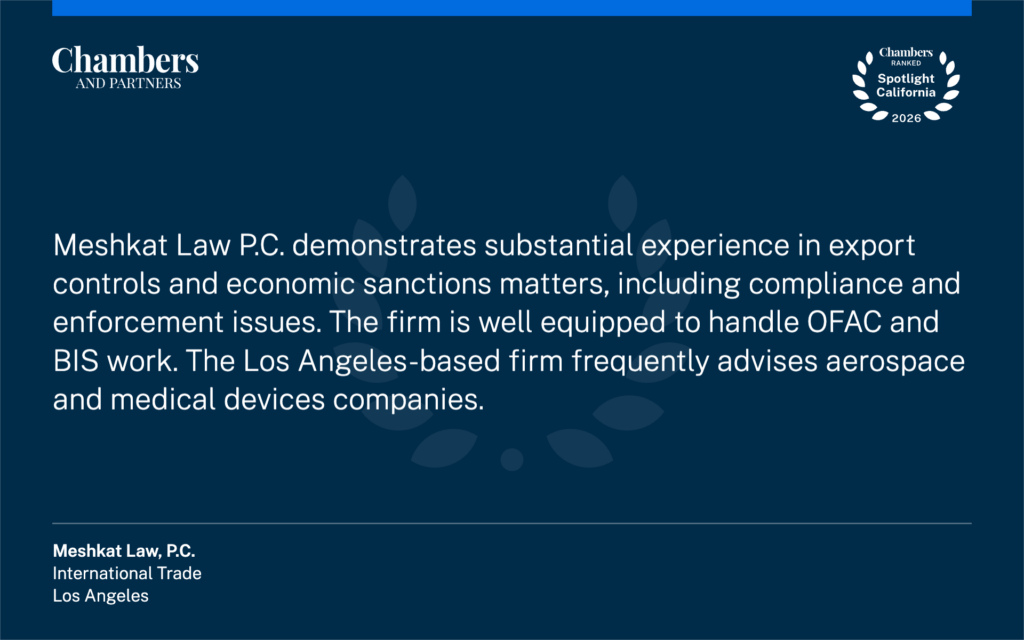
Meshkat Law stood out for its exceptional work and is recognized in International Trade, building on its prior recognition in the Chambers USA California Spotlight Guide 2025 for the same practice area.
Kian Meshkat, principal attorney at Meshkat Law, expressed the firm’s gratitude: “Meshkat Law is honoured to be recognized by Chambers and Partners in their Spotlight Ranking for California. This acknowledgment reflects our commitment to providing top-tier legal services tailored to the unique needs of our clients and the complex matters that we help them navigate.”
This recognition underscores Meshkat Law’s position as a key player in California’s legal landscape, offering clients throughout the state access to high-quality legal representation that combines big-city expertise with local specialized support.
“Meshkat Law is delighted to be recognized by Chambers and Partners in their Ranking. This recognition is down to the quality of work that we provide our clients and the complex matters that we help them navigate.”
Background to Firm
Meshkat Law, P.C., is a boutique law firm specializing in U.S. economic sanctions and export controls matters. The firm represents clients around the world before the U.S. Department of the Treasury’s Office of Foreign Assets Control (OFAC), the U.S. Department of Commerce’s Bureau of Industry and Security (BIS), the Financial Crimes Enforcement Network (FinCEN), and other national security, trade, and financial‑regulatory agencies, providing pragmatic guidance for senior management on sanctions, export controls, and other cross‑border regulatory risks.
Meshkat Law offers a full‑service U.S. economic sanctions, export controls, and related national security practice:
- Advising companies, financial institutions, and individuals on U.S. sanctions and export controls compliance requirements and best practices, including risk assessments, policies, and training.
- Representing clients before OFAC, BIS, and other U.S. agencies in licensing, classifications, unblocking applications, voluntary self‑disclosures, and related submissions or petitions.
- Advocating for clients to achieve favorable resolutions in investigations, subpoenas, enforcement actions, list removals, and related litigation.
Based in Los Angeles, Meshkat Law represents clients across the United States and around the world in U.S. sanctions, export controls, and related national security matters.
Background to Chambers and Partners
Chambers and Partners has over 30 years of US research in the Legal Market and therefore uniquely placed to identify markets where there is a significant collection of leading smaller firms, Chambers is on a mission to uncover the best legal talent wherever it may be.
Chambers is on a mission to uncover and champion the best legal talent across the United States, wherever it exists, starting with shining a spotlight on select states in 2024.
Chambers sought to identify the leading small to medium-sized law firms offering a credible alternative to Big Law. The ranked firms were selected based on independent and in-depth market analysis, coupled with an assessment of their experience, expertise and calibre of talent.
Chambers Spotlight covers Pennsylvania, Massachusetts, California, Illinois, Ohio, Texas, Georgia, Florida, North Carolina and New York State.
For questions, please contact: Kian Meshkat at meshkat@meshkatlaw.com.